Liquid Lens for Optical Image Stabilization (OIS)
A second generation of liquid lens has been developed for mobile digital photography, in all situations where the quality of digital picture counts, and/or when one cannot afford to try several times to get the good shot, especially with children, friends etc…
- Mobile photography
- Mobile photography in medium light (restaurant, indoor situations…)
- Mobile video
The progresses made in camera module's optics quality have made the intrinsic blur coming from the camera itself negligible. Major source of blur are now extrinsic:
1. Focus blur, when the imagers are not equipped with an AF actuator impacting visualpicture quality due to the lack of precise control of the focus.
2. Handshake blur: the miniaturization of camera phones have degraded their light sensitivity and under medium light illumination, images are blurred due to a longer time exposure than the one experienced with a Digital Still Camera (DSC). Optical Image Stabilization is a key requirement to produce a good picture and, Varioptic OIS liquid lens is the ideal solution to achieve a high image quality while keeping a very small camera format.
Varioptic is the first company to have developed a lens that effectively and simultaneously performs superior Auto-Focus and Optical Image Stabilization, correcting both major sources of blur.
This new generation of liquid lens, with a multi- electrodes design (see picture below), allows tilting the light in all directions of space and, at the same time, to refocus the light.
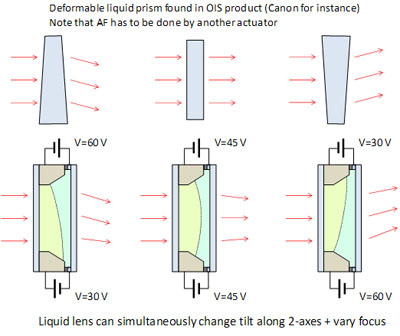
The ability to tilt the light enables camera module manufacturers to use our liquid lens to activate Optical Image Stabilization by measuring the handshake and compensating in real time with the liquid lens. This lens uses 4 electrodes to enable tilts and non symmetrical shapes necessary to simultaneously support Auto-Focus and Optical Image Stabilization:
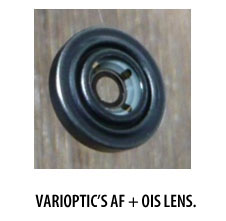
The optical design of a camera module with the liquid lens OIS+AF obeys to the same general rules as for the AF case: locate the liquid lens as close as possible to the aperture stop plane. Electronic design uses information coming from a gyroscope, either "image dedicated", or shared with multimedia applications. The gyroscope signal processing is very similar to DSC stabilizing systems, with some minor adaptations.
- Effectively corrects most of the handshake blur: with picture integration time up to 400ms, 90% of pictures have their maximal handshake blur within the tilt correction range of the liquid lens.
- Response frequencies optimized for mobile photography.
- Long exposures enabled (up to 1s)
- In AF macro mode, focus range is maintained very wide, enabling excellent focus at distances from 3cm to infinity.